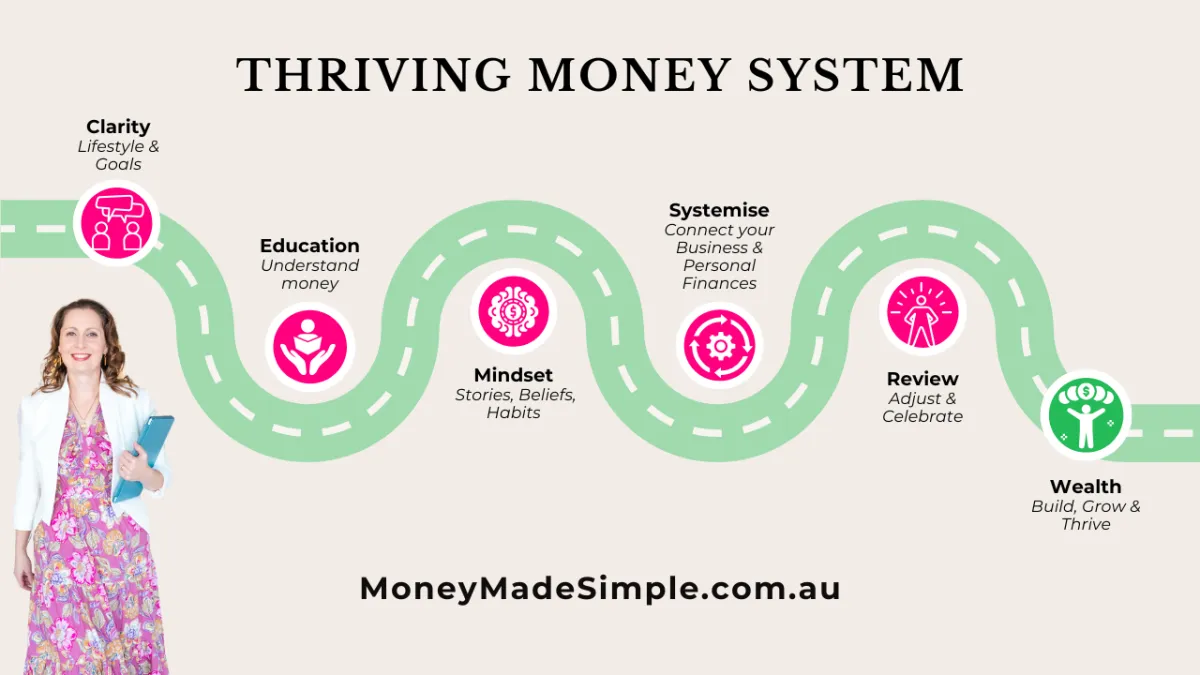
The Thriving Money System: The 6 Steps I Use With Every Client (Including Myself)
Let me ask you something. When your money feels like it's slipping, do you know exactly where to look to find the problem?
Most people don't. When things feel off financially, the response is usually a vague sense of dread, a lot of avoidance, and eventually some frantic activity that doesn't actually fix anything. The problem isn't effort. It's that there's no system to go back to.
That's what I want to talk about today. Because I've been a bit closed off about this, to be honest. The Thriving Money System is the framework I use with every single client I work with. It's also what I use myself. And I've realised it's time to share it more widely.
So here it is.
The 6 steps are: Clarity, Mindset, Education, Systemize, Review, and Wealth.
Before I walk through each one, I want to address the thing you're probably already thinking: does this have to go in order? No. Think of it like a jigsaw puzzle. You don't always start with the corners. Sometimes you see a section of the picture forming and you build from there. What matters is that all the pieces eventually come together. You just need some clarity and mindset work under your belt before you fast-track to the wealth end of things.
Okay. Let's go.
Step 1: Clarity
This is the one that gets skipped most often, and it's the one that makes everything else harder when you do.
Clarity is not just about knowing your numbers. It's about knowing what you actually want your life to look like. Not what you think you should want. Not the default path you've been on. What you, at your core, want.
This is harder than it sounds. Most of us have spent years filtering our wants through what seems realistic, what others expect, what we've already committed to. Stripping all of that back takes time and often some outside help.
Once you're clearer on your lifestyle vision, the goals almost write themselves. Because a goal without a "why" behind it is just a to-do item. When you know you want to live near the water, or that you want the choice to work three days a week, or that you want to retire at 58 rather than 68, those things become anchor points. They give your money somewhere to go.
Step 2: Mindset
Mindset is an overused word, so let me be specific about what I mean here.
This is about the stories you carry around money. Where they came from. How they've shaped the habits you have and the decisions you make. And whether those stories are moving you toward what you want, or just away from what you fear.
A lot of this is generational. Your parents' relationship with money, your grandparents'. The scarcity that came from wars, recessions, instability. And for women specifically, there is a layer of gender history here that we don't talk about enough. It wasn't long ago that women couldn't hold a bank account in their own name. Couldn't work without their husband's permission. That history lives in our bodies and in our nervous systems, whether we've consciously thought about it or not.
Understanding this isn't about therapy for its own sake. It's about pattern interruption. You can wait for a forced pattern interrupt, which might look like a job loss, a health scare, or a sudden financial shock. Or you can choose one deliberately. I strongly recommend the latter.
The goal of the mindset work isn't to analyse everything to death. Sometimes you just need to draw a line and decide to move forward anyway. What you're really building is self-trust around money. That's what changes behaviour.
Step 3: Education
There is a real knowledge gap when it comes to money for most people. Not because they're not intelligent. Because we're simply not taught this stuff. Not in school, not at home for most people, and often not even by the professionals we hire to manage our finances.
Education at this stage looks like understanding the basics: what different types of investing mean, how your business money connects to your personal money, what terms like gearing or compounding actually mean in practical terms. It doesn't mean you need to become an expert. You need to know enough to make informed decisions.
Here's the thing though. If you hit the education step and feel yourself resisting, going blank, or suddenly finding every other task more urgent, that's worth paying attention to. That resistance is usually a mindset thing in disguise. Which is why these steps loop back on each other.
The best financial education, in my experience, comes through doing. Through making decisions, seeing the results, adjusting. You don't need to read every book. You need enough understanding to take the next step with confidence.
Step 4: Systemize
This is where it starts to feel real.
Once you have some clarity on what you want, some understanding of what's been getting in the way mentally, and a working vocabulary around money, you set up a system. Your day-to-day money gets a structure. Every dollar has a direction.
I use the Money Pie framework for this. It's a way of allocating your money into meaningful categories so that your spending, saving, and investing happen automatically, not just when you remember. Once you understand why the system is built the way it is, you can automate it. Money moves from here to there without you having to make the decision every time.
This is the step where I regularly see clients have what I call the "why did I not do this sooner" moment. Because what felt like this enormous, complex, overwhelming thing suddenly just... works. And once it's working, you can put your energy elsewhere.
One thing I want to flag here: please make sure you actually understand the system you're running. I work with clients regularly who have money moving between multiple accounts in ways that made sense years ago but no longer do. They're often paying extra fees, carrying unnecessary complexity, and no one's ever suggested reviewing the structure. Understanding the why behind your setup means you can catch these things.
Step 5: Review
We don't live in a vacuum. Your life changes. Tax laws change. Interest rates change. Your income changes. Your goals change.
The review is how you keep the system aligned to your actual life rather than the life you had when you set it up.
I do a quarterly performance review and a more thorough review every 6 to 12 months. I also do a triggered review when something significant happens, like a budget announcement that affects my investments, or a change in household income.
The review isn't just about the numbers. It's also a check-in on the system, on your mindset, on whether your goals still reflect what you actually want. Things shift. That's not failure. That's life.
Step 6: Wealth
This is where all the groundwork pays off.
By the time you get here, your system is running, your money has direction, and you've built some real momentum. The "problem" at this stage is actually a good one to have: what do you do with the wealth you're building?
This includes things like how you structure your investments, how you protect what you've built, and how you plan for the future. Estate planning. Superannuation beneficiary nominations. Whether a self-managed super fund makes sense for your situation. Retirement planning. These are not glamorous topics, but they are important ones. And they're far less painful to deal with when you've done the work in steps one through five first.
So where do you start?
Wherever you are right now.
If you've never really sat down with your lifestyle vision, start with clarity. If you know exactly what you want but you can't seem to make yourself take any action around money, the mindset step is probably where the work is. If you've got a reasonable handle on both but your money is still not building the way you want it to, the systemizing step is likely the missing piece.
The point of the Thriving Money System isn't to start at step one and arrive at step six in perfect order. It's to give you a map. So when something feels off, you know exactly where to look.
If you want to explore where you're at right now and which step is most relevant for you, book a free Clarity Chat. It's 15 minutes on the phone. No pitch, just clarity.