"But How Do I Actually Invest?" The Question I Get Asked More Than Any Other
Before I started share investing, I had exactly the same question you probably have right now. How do you actually do it? Like, physically? Is there a special place you go? Do you need to ring a stockbroker? Is there a secret handshake?
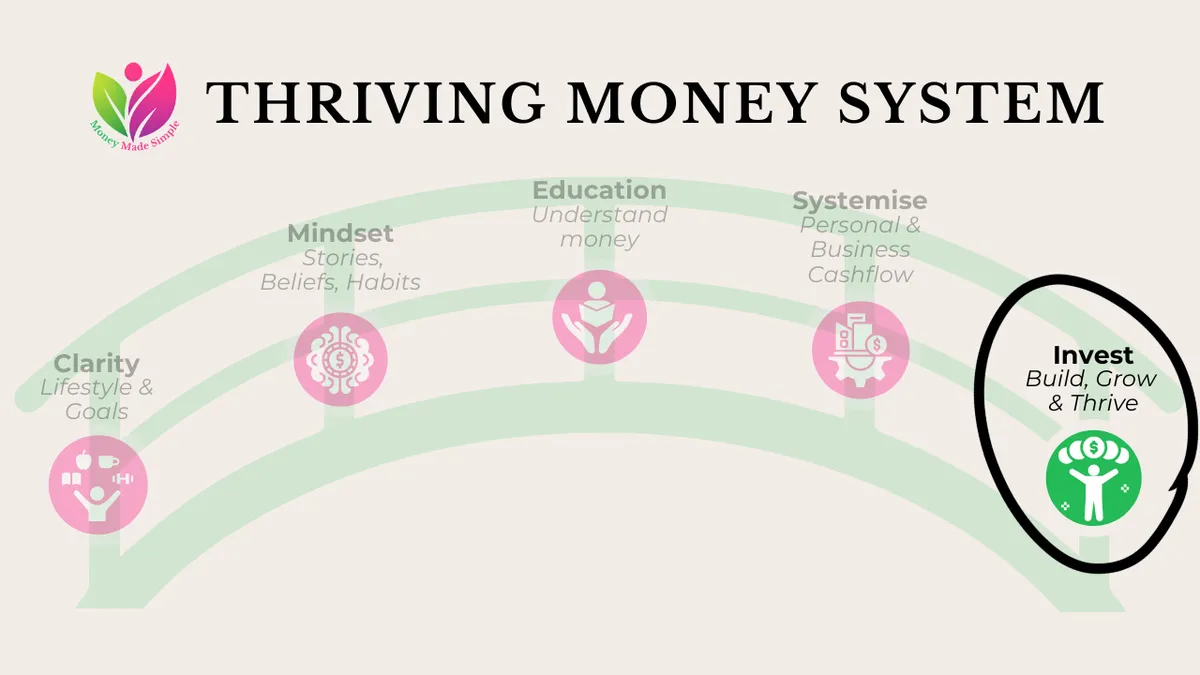
Back in the 80s and 90s, the answer was pretty much yes, you rang a stockbroker and paid them a fee. Now it's an app on your phone. But before I get into the how, I want to talk about why investing is the last step in my Thriving Money System, not the first. Because that order matters.
Why investing comes last
The Thriving Money System has five steps. Clarity (what do you actually want money for). Mindset (the stories and habits keeping you where you are). Education (working out what you actually need to know, not everything). Systems (setting things up so you're not doing the same thing over and over). And then, finally, Invest.
I know it's tempting to skip straight to the end, especially with everyone on TikTok telling you how far ahead you should be at your age. But your money decisions depend completely on what you want. Do you want to travel around Australia in a caravan? Go trekking? Leave a legacy for your kids? Retire early? Those answers change what you build and how you build it.
It also depends on who you are. I've literally had clients sitting in front of me shaking because of the amount of debt they had. Someone else could carry the same debt and sleep like a baby. Neither is wrong. But if you don't understand yourself first, you can end up with an investment strategy that looks great on paper and keeps you up at night.
And the plan isn't set in stone. Your life changes, so the plan changes with you. Money gives you choice.
What wealth actually is
Wealth is anything that grows your money, ideally with as little effort as possible. But it needs time. And it's worth looking a bit closer at what "growth" really means.
People say to me, "just buy gold." And sure, gold has gone up in value over the decades. But say you bought $1,000 of gold years ago and it's worth $2,000 now (these are not real numbers). Sounds like you've doubled your money. Except that the original $1,000, in today's dollars after inflation, might be worth something like $1,800. So, your real gain is closer to $200. And for all those years, the gold sat there doing nothing. No income. Nothing until you sell it.
Same with the house. "We bought it for $500,000, now it's worth a million!" Okay. But how long have you had it? How much interest have you paid? What did you spend on maintenance and repairs? What will it cost to sell? The headline number is only part of the story.
If it's an investment property, though, you've hopefully been getting rent the whole time, which helps pay it down. That's the difference between capital (the value going up) and income (money coming in while you hold it).
Most people want a mix of both. In the early years you're usually more interested in growth. Later on, income matters more. My mum is 82 and hasn't worked in over ten years, so for her, income is what counts. Your investments have a purpose, and that purpose will change over time.
It's not "and then." It's "and."
People often think investing is a queue. Pay off the house, and then start investing, and then do super, and then... It doesn't have to work like that. Property, shares and superannuation can all run in parallel, depending on your situation and how much you have to work with.
Each professional sees it through their own lens (which is understandable). Real estate agents see property. Financial planners are often shares and super focused. Your accountant is (hopefully) looking at tax strategy as well as compliance, but they're not going to check you have an emergency fund or help you set up a system to put your tax aside.
This is the gap I sit in. I've spent my whole career connecting people and teams to gain the full perspective. Making sure the accountant knows what the planner is doing, the lawyer knows what structure the accountant suggested, and nobody's accidentally left the king and queen exposed on the chessboard. I see so many clients who got advice from one professional that caused a problem with another, and they don't find out until years later.
And it matters even more right now. The 2026 Federal Budget changed the rules around negative gearing, capital gains tax and trusts, with changes phasing in over the next couple of years. If you own property, or you're thinking about it, this is a good time to talk to a knowledgeable accountant (and an estate lawyer) about what it means for you. If you have more investments, then bring in a financial planner as well.
So, how do you actually invest?
Here's the practical bit. I'll share what I do, but please treat this as an example, not a recommendation. Do your own research and get advice for your situation.
What I do:
Micro-investing apps, like Raiz. Your money is pooled with other investors, so you own a slice of a portfolio rather than the shares directly. Great for starting small.
Online investing platforms and apps, like Pearler, Vanguard's investor platform, Betashares, CommSec and Bell Direct. Some give you a HIN (Holder Identification Number), which means the shares are registered directly in your name. Others hold them on your behalf. It's worth understanding the difference before you choose.
I started with Bell Direct, but I wanted to invest regularly without paying a trading fee every time. So, when Vanguard opened their own platform, I moved over.
Most of what I hold is ETFs (exchange traded funds, basically a bundle of lots of companies in one purchase). I started with three: one Australian, one US, and one covering the rest of the world. I just kept buying them, reinvesting the dividends every quarter, and letting it tick away.
Then, I'll be honest, it got a bit boring. So, I started looking at other ETFs covering different themes and industries, and I've added an Australian income-focused one too. Australian shares have an extra perk worth knowing about: franking credits. The company has usually already paid tax on its profits, so you get a credit for that tax when you receive the dividend. If your tax rate is lower, you can even get some back.
Placing a trade is less scary than it sounds
You log into the platform, pick what you want, and choose either a dollar amount or a number of units. It'll give you options either side of your number (you can't usually buy exactly $1,000 worth, so it might be $996 or $1,011). Many platforms now let you place the order any time and it fills when the market opens, so you don't have to watch the clock. The ASX trades roughly 10am to 4pm Sydney time, which here in Queensland means 9am to 3pm during daylight saving.
Once you're comfortable, set up auto-invest. Same day each month, same split across your chosen investments, and off it goes.
When should you start? Now.
You probably saw that coming. There's no perfect time. Markets dip. But if you keep buying regularly (that's called dollar cost averaging), sometimes you buy low, sometimes high, and over time history says it tends to go up. Not guaranteed, but that's where your research comes in.
My biggest regret? Not starting ten years earlier. Having Superannuation helped, but I could have done so much more, earlier.
That's why I started investing for my daughter the moment I had her birth certificate in my hand. I set up an investment bond, pooled some money with family to kick it off, and worked backwards from a goal for when she turns 21. She's 11 now and we're more than halfway there. The next challenge is making sure she knows how to handle it. But what it gives her is choice, so she's not starting life behind the eight ball.
That's the whole point of this series, really. Money gives you choice.
Where to from here
If any of this has you thinking "I have questions," good. That's what my free Discovery Chat is for. Sometimes it's a quick "talk to your accountant about this bit." Sometimes you just need to say it out loud to someone. Either way, you don't have to work it all out alone.