You Don't Need More Discipline. You Need a System
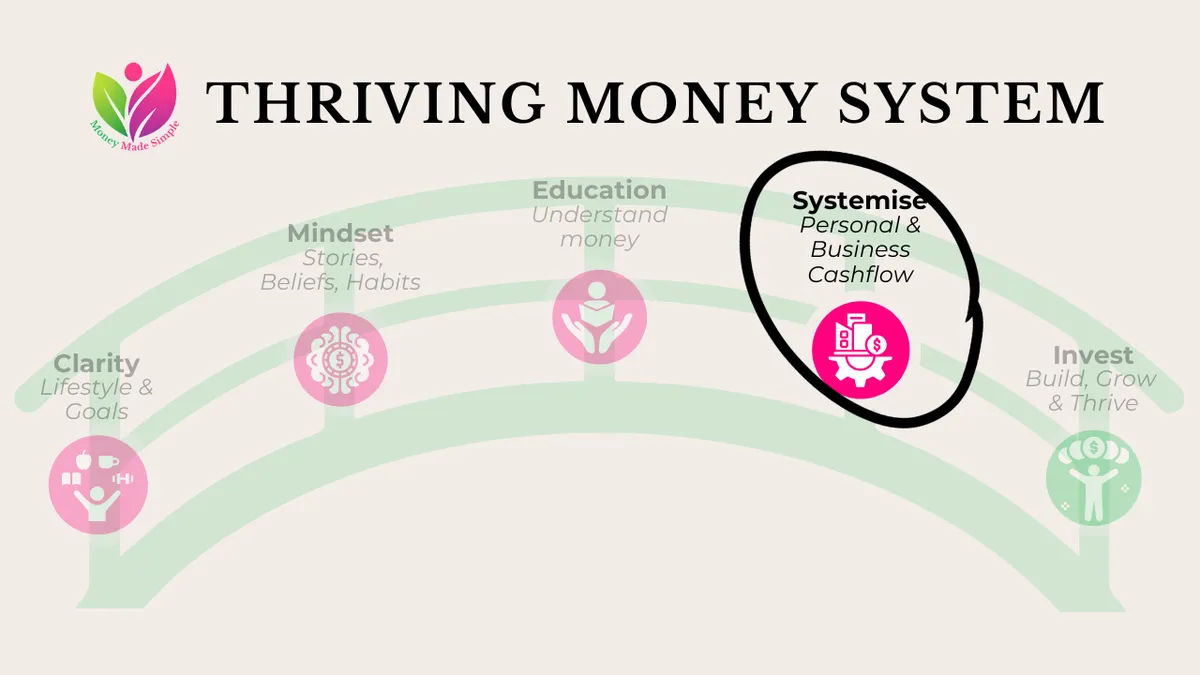
If you've been following along with the Thriving Money System series, here is a quick recap. Step 1 was clarity, working out what you actually want your money to do for you. Step 2 was mindset, because you can have all the clarity in the world and still self-sabotage if your brain thinks change is dangerous. Step 3 was education, and specifically the right education for where you're at, not a generic "go learn everything about money" overwhelm-fest.
This week is step 4, and it's one of my favourites: Systems (because I really don't like doing boring things over and over again).
Here's the thing about a system. It's not another app. It's not five new bank accounts (because you saw a social media post that said it was a good idea). It's structure.
Think about building a house. You can have a pile of bricks and a lot of enthusiasm, but if there's no architect's plan behind it, you're going to end up with a wall that's too tall for the wall next to it, and then you can't put a roof on, and then the roof leaks. The bricks matter, but only if they're going into a structure that was actually designed.
What a system actually needs
A real money system has five things going for it:
Structure. This is the "if this happens, I do that" logic. If money comes in, here's what happens to it. If a bill is due, here's how it gets paid. You're not deciding from scratch every single time.
Consistency. Boring word, with an incredibly powerful outcome. When you do the same things the same way every time money moves, you stop leaking energy on decisions you've already made, and you benefit from the power of compounding.
Organisation. This one has a caveat. Being organised is essential, but there's a point where "ultra-organised" tips over into its own kind of chaos. If you've got money split across ten different accounts for ten different purposes, you can lose the plot just as easily as if you had one account and no plan at all. Organised doesn't mean complicated.
Repeatability. Whatever you do when money comes in, or goes out, needs to work the same way next time. Automatic transfers. A rule for how you handle a bonus, a tax refund or another sort of financial windfall. You shouldn't have to reinvent your approach every pay cycle.
Flexibility. This one is important. Your system has to bend with your actual life. If your income isn't the same every month, and for a lot of business owners it isn't, fixed dollar amounts don't work. Percentages do. If you can only pay yourself a consistent wage some months, then work in percentages of revenue instead, and let the system flex with you rather than break every time life does something unexpected.
And then there's Automation. Anything you can hand over to technology, hand over to technology. Direct debits, automatic transfers into savings or investing, automatic categorisation of spending. The less of this that depends on you remembering to do it manually, the more likely it actually happens.
Why I built Prosperess
I didn't start with software. I started with an Excel spreadsheet, years ago, because I understood Excel and it let me build smart tables with formulas and a dashboard that did some of the thinking for me. Over time, working with clients, that spreadsheet got more sophisticated. But it still needed a lot of manual input, and I kept thinking there had to be a smarter way.
That's how Prosperess came about. It's the same system, just automated and more connected. All your transactions land in one dashboard, so you can see everything together instead of having your banking app tell you one thing and your accountant's numbers tell you another. It pulls your bank data in automatically. AI does a first pass at categorising your spending (it's not perfect, so you do need to check it), and then you can actually see where money is going.
From there, the system uses what I call the Money Pie. Instead of buckets, think of it as slices: an emergency fund, a fun fund for things like travel, money set aside for your kids, and a slice for investing. You can run this in percentages if your income moves around, or fixed dollars if it's steady.
Then it connects to the bigger picture, your net worth. How is your wealth actually building over time, not just what happened in your bank account this month. There's a loan payoff calculator, a retirement calculator, and future projections so you can see, based on what you're doing today, roughly where you'll land in 5, 10, 15, or 20 years. If you're in a relationship, there's a couples mode too, because managing this separately when you're building a life together rarely makes sense.
And if you run a business, the same Money Pie concept applies there, just with your business cash flow instead of your personal income. Keeping those two systems distinct, but built the same way, stops the mental spaghetti of "wait, is this a business expense or did I already account for that personally?"
Why this isn't just a budgeting app
A budgeting app can tell you what you spent yesterday. That's useful, but it's not a system. What it usually can't tell you is whether the money moving between your own accounts is actually being spent, or just being transferred, which throws off your real numbers. It usually can't show you what you're building over time. And it definitely can't show you whether your business is paying you enough to fund the life you actually want, or whether you're quietly propping up your business with your personal money without realising it.
That confusion, when there's no system underneath it, doesn't just cost you peace of mind. It makes life harder for your accountant too, and the messier things are, the more that costs you.
One more thing: a system isn't set and forget
I wish I could tell you that once it's built, you never have to look at it again. Some parts, sure, you set them up once and they run. But the system as a whole needs regular review. Is it still getting you where you want to go? Has anything changed? That check-in is part of the system too, not a separate chore.
If you've got your clarity, you're working on your mindset, and you've picked up the knowledge you need, the system is what actually holds it all together day to day. It's not about being naturally good with money. It's about having a structure that does the remembering for you.
Next week, we move to step 5: invest. That's where we talk about actually growing the wealth this system is building space for.