How a Picture Book About Bunnies Teaches Kids and Grown Ups about Money
A few weeks ago my daughter told me that spending money is fun.
She's right. It can be fun. You hand over some money, you get lollies or a toy or another squishy, and you get that little hit of dopamine (aka happiness) straight away. Saving, on the other hand, is boring. The money just sits there. Nothing happens. There's no reward, at least not immediately.
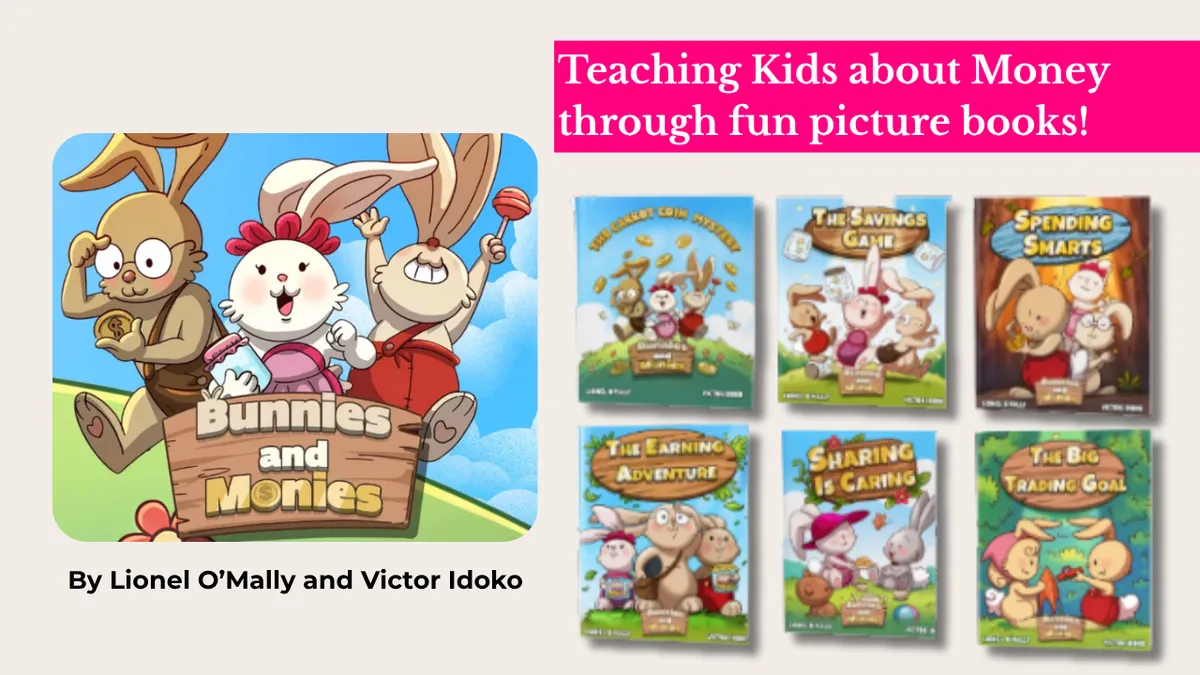
I've been thinking about that conversation a lot, especially after recording this week's episode of Money with Alpha with Lionel O'Mally. Lionel is a financial planner who works with pre-retirees and retirees. He's also a dad of three, and he's co-written a series of six children's books called Bunnies and Monies with another planner, Victor Idoko.
When he reached out to me on LinkedIn, I'll admit I was curious. A retirement specialist writing picture books? But the more we talked, the more it made sense. He sees the end of the money story every day. The books are his attempt to fix the beginning.
Nobody taught us, so we assumed it was hard
Lionel said that every night he and his wife read to their kids from a whole shelf of books. And not one of them taught anything about money.
Think about your own childhood. You learned to read, to share toys, to say please and thank you. But money? Most of us picked it up by osmosis. We watched what our parents did (or didn't do), we felt the tension when bills came in, and we made our own mistakes as young adults.
So it's no wonder so many smart, capable women I work with believe managing money is complicated. It feels complicated because nobody ever broke it down for us.
The Bunnies and Monies books start with something beautifully simple: three jars. Save, spend, share. Every time money comes in, you decide what goes where.
That's not just a kids' system. That's a money system. The grown-up version has more jars and bigger numbers, but the idea is exactly the same. Money comes in, and you give each dollar a job before it disappears.
You don't have to be the expert
Just because you can do something doesn't mean you can teach it. And the reverse is true too. You don't have to have it all worked out to start teaching it.
So many parents I talk to feel like they can't have money conversations with their kids because they're still figuring out their own finances. There's a bit of shame in that, a feeling of "who am I to teach this?"
But a book like this takes the pressure off. The structure is already there. You read the story, you talk about the jars, and you learn alongside your child. Honestly, some of the best money conversations I've had with my daughter have made me look at my own habits more closely.
My daughter has had jam jars for years. Hers are called Save, Spend and Give. She's 11 now, so she's getting a bit old for them and we're moving towards actual bank accounts that do the same job. But the thinking hasn't changed.
For her Give jar, I asked her to think about what mattered to her. She chose animals, and she also supports a local charity for homeless women over 55 (The Forgotten Women). We do a sleep-in-your-car fundraiser for them every year. So, her give money goes somewhere she cares about. At the same time, she knows she's looking after herself because she has her Save jar, and she can still buy things she wants because she has her Spend jar.
That's balance. And balance is the part most adults are missing.
The next "jar" that I'll introduce her to is "Invest", now that she is getting old enough to not only understand it, but be interested in investing.
Money you can't see is money you don't understand
Lionel made a point that I think applies just as much to us as to our kids.
We tap, tap, tap our cards and phones all day. Kids watch us do it and they have no idea what anything costs. A $10 transaction and a $10,000 transaction look exactly the same from the outside.
But if you give a child a $10 note to buy something and it isn't enough, they learn about value very quickly. That little rejection teaches them something.
I ran into this recently when my daughter went on her first day trip to a theme park with another family. I wanted to give her a set amount of money so she didn't spend the whole day eating lollies. But the park didn't take cash. So I ended up using a spare bank account, locking it down so it could only be used for tap payments, and putting $50 in it. That was her budget for the day, lunch included.
It worked, but I remember thinking I'd much rather have handed her a few notes she could actually see and feel. She had no idea how much she had spent, or what anything cost because she didn't physically pay for things, and then make sure that she received the right change (which is also a good way to learn maths).
Think about your own money. How much of it do you actually see? If most of your spending happens with a tap, and your business and personal money are mixed together, it's very hard to get a feel for what's going where. That's not a character flaw. It's a visibility problem. And visibility problems are fixable.
Give your money somewhere to go
One of the books in the series is about spending wisely. It's based on Lionel's son Harvey, who loves lollies. In the story, Harvey spends all his money on a bag of jelly beans, eats the lot, and ends up with a sore tummy. Meanwhile his sister has saved up and bought a train set that she gets to play with again and again.
Then Dad suggests Harvey save for something big. Like a house.
I love that. Planting the idea early. Because if you don't have a goal, money just drifts away. I see this all the time with clients. "I don't really know what I want money for," they tell me, "so it just disappears." It's a bit like health. If you have a target, you work towards it. If you don't, you pitter-patter around and never really get anywhere.
Lionel talked about having a goal jar you can see filling up over time. That visible progress is satisfying and it keeps you going. It works for a six-year-old and it works for a grown up too.
The other end of the story
Here's where Lionel's day job comes in. He works with retirees, and he talked about something called unspent capital. It's money people could have spent and enjoyed during retirement, but didn't, because they were scared they wouldn't have enough.
People spend their whole working lives saving, and then when it's time to spend it, they can't. It's a complete mindset shift, and many people never make it.
That's why I don't believe good money management is about saving as much as possible. It's about knowing what your money is for. Saving from fear and saving with purpose feel very different, and they lead to very different lives.
Where to start
If you have young kids, grab some jars and start the conversation, even if you feel like you're still learning yourself.
And for you, ask yourself a simple question: if your money had three jars right now, would you know what's in each one? If the honest answer is "not really," you're in good company. That's exactly the kind of clarity we work on as part of the Private Mentoring work that I do, where we connect what's happening in your business to what you're building personally, without judgement and without the overwhelm.
You can find the Bunnies and Monies books here.
Of you would like to know more about Private Mentoring and see if it's right for you, book in for a free Discovery Chat.