What Your Body and Your Money Have in Common
I've been thinking about this a lot lately. The way we talk about money blocks and the way we talk about emotional blocks are almost identical.
Avoidance. Shame. The sense that something is stuck and you don't quite know how to move it. The belief that if you just ignore it long enough, it'll sort itself out (it won't).
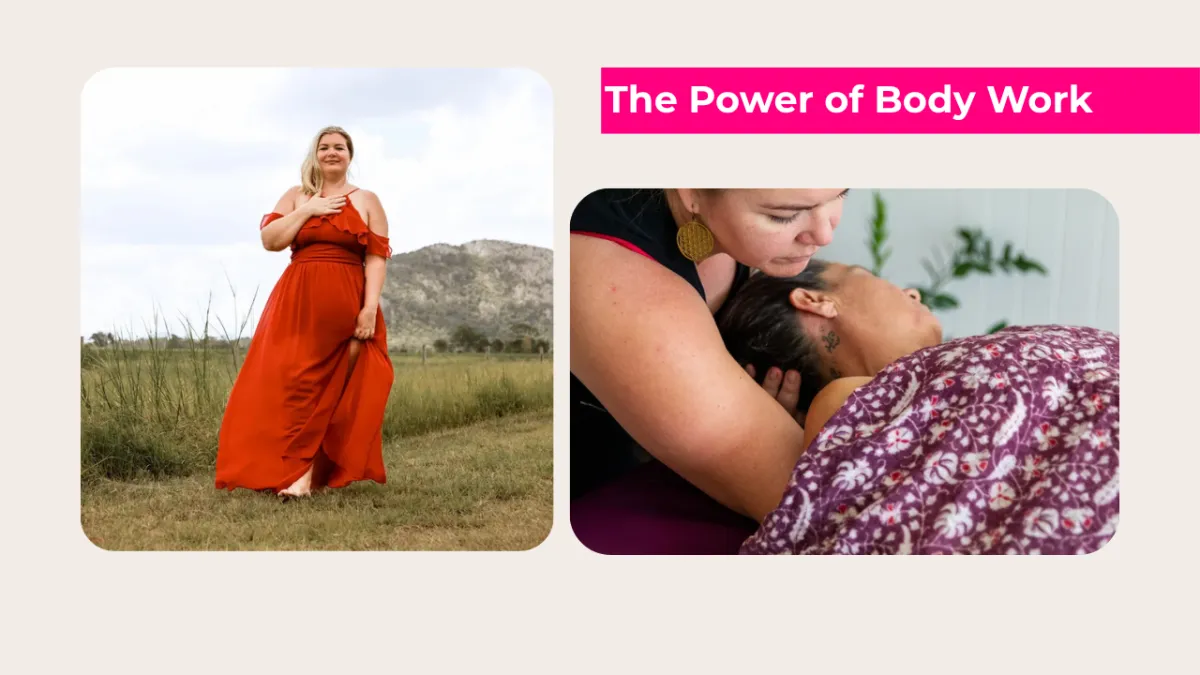
Recently, I had a fascinating conversation with Jo Goddard, founder of I'm Her Women's Wellbeing. Jo is a bodyworker: Kahuna massage, Lomi Lomi, energy healing, sacred sexological bodywork, and more. She holds space for women, especially when they are in seasons of transition. And while body work isn't my usual territory, I couldn't stop drawing parallels to what I see with money.
Let me share a few things that landed for me.
Touch is a survival language, not a love language
Jo said something I hadn't heard put quite like this before: "Touch is not a love language, it's a survival language. It's how we know we belong. It's how we know we're safe."
She works with women who resist touch. And instead of accepting that as a fixed personality trait — "oh, that's just how they are" — her instinct is to get curious. At what point did touch become unsafe for you?
I think we need to ask the same question about money.
At what point did money feel unsafe? When did it become something to avoid, to be suspicious of, to hold at arm's length? For a lot of the women I work with, there's a very specific moment. A family money dynamic. A business that went under. A relationship where money was used as control. A parent who never talked about it, so the message became: this is not for you to understand.
We don't arrive at money avoidance randomly. Something taught us it wasn't safe.
What gets stored in the body
Jo talked about what she sees happen on the table during a session. Women start to cry. Or laugh uncontrollably. Or process something they've been carrying for years — without even knowing why.
She said right now she's seeing a lot of suppressed rage in her clients. And when it finally has space to move, it comes out as tears. Often with a layer of grief attached — grief for all the years they didn't let themselves feel it.
I had a moment like this at a sound bath a few weeks before we recorded this episode. I just started crying. I didn't even know what I was crying about at first. And then it became clear — I'd been holding something since I was eleven years old.
This is what happens when we don't process things. They sit there. In the body. In the nervous system. Quietly running the show.
Money avoidance works the same way. When you haven't looked at your bank account in three months, it's not because you're lazy or irresponsible. It's because looking at it triggers something that feels unsafe. And until you create a structure that makes it feel safer, the avoidance is actually a rational response to an irrational amount of stress.
The work is creating safety. Not just more information.
Jo's money story
One of the things I always find valuable in these conversations is hearing someone's actual money story — how money showed up in their childhood and what it taught them.
Jo grew up comfortable. They wanted for nothing. But when her parents separated, she watched money become a weapon. A tool for manipulation. Something that got withheld, bargained with, used to control behaviour and loyalty.
She also told me about a pocket money book from when she was a kid. She'd been earning money doing chores, but instead of being paid in cash it was tracked in a book. When her family moved house, the book got lost. Two hundred dollars owed to her — a lot of car washes at $4 a pop — just gone. And with it, the thing she'd been saving for. A Discman.
She said: "It wasn't just the money. The dream was gone."
That's the part people miss when they talk about childhood money experiences. It's never really about the money itself. It's about what the money represented. Safety. Choice. Possibility. And what it means when that gets taken away.
For Jo, the takeaway was: earn your own money as soon as you possibly can. Financial independence is the only way to not be controlled by it. I heard a very similar version of that story from my own experience.
The barter trap — and why real money creates a bigger ripple
This part of the conversation was particularly relevant to anyone in the wellness, coaching, or service space.
Jo talked about the well-meaning culture in the wellness industry of doing exchanges. "I'll massage you if you massage me." Barter. Swaps. And she's not dismissing the concept entirely — but she made a point that I think is worth sitting with.
Exchanges feel generous and abundant. But they often don't create the ripple effect that actual money does.
She used this example: a client mentioned her husband was starting a mowing business. There was a natural conversation about whether he could mow Jo's lawn in exchange for massage. And Jo's response was — actually, I'd rather pay him.
Because if she pays him, he can invest that money in equipment, serve more clients, grow his business. If she massages him in return, that's where the value chain ends.
She wasn't dismissing the human connection in the exchange. She was pointing out that money, when it flows, creates movement. And that movement reaches further than the original transaction.
The practical advice here: be discerning about when you do exchanges. If it's something both parties are actively seeking and the value is genuinely equivalent, go for it. But don't let "I'll barter you" become a default that stops money from flowing through your business.
Investing in yourself is not cancelled
The other thing that struck me in this conversation was what Jo is seeing in her business right now.
Everyone is talking about the economy. How tight things are. How people are pulling back. And there's truth in that — consumer spending is more careful. But Jo said something worth noting: her inquiries haven't dropped. If anything, the quality of them has gone up. People who reach out now are ready. They're not shopping around, they're booking.
Her read on it: people are being more discerning with where they spend. But they're still investing in themselves. Maybe even more so, because they recognise the value of their own wellbeing more clearly when everything else feels uncertain.
And she made a distinction that I want you to hold onto: discernment is not the same as scarcity.
Being discerning means you're clear on what's worth it. Scarcity means you believe there's not enough and you're in protection mode. One is a conscious choice. The other is a nervous system response.
The same is true with money management. There's a difference between "I can't afford this" and "this isn't a priority right now." We will always find the money and the time for the things that are genuinely a priority. The question is whether you're making that choice consciously or just reacting to what feels urgent.
The through-line
What Jo does with bodies and what I do with money are more similar than they might look from the outside.
Both involve helping someone create safety in a space that previously felt unsafe. Both require moving through the stored stuff before you can build something new. Both work better with structure and support than with willpower alone.
And both, in the end, are about helping women feel like they actually have a say in their own life.
That's worth investing in. Regardless of what the economy is doing.