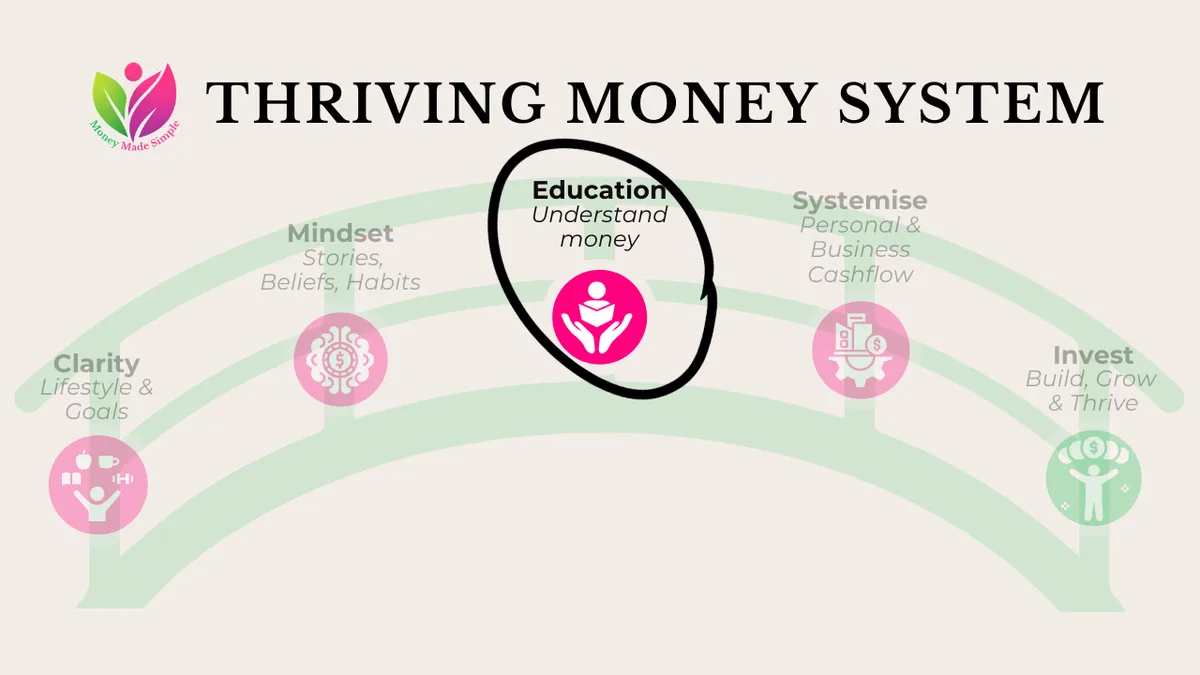
Education: You Don't Need a Finance Degree. You Just Need These Six Concepts
This is Part 3 of the Thriving Money System series, and it's on a topic that comes up a lot in the work that I do - Education.
Before we get into it, here is a quick recap. Part 1 was Clarity. Part 2 was Mindset, the beliefs and stories and language that quietly run the show when it comes to money. This week is Education, which is pillar 3 of 5.
When people hear "financial literacy," they usually think the answer is just to know more. Teach it in schools, and problem solved. I used to think that too. I've actually run financial literacy sessions for both younger kids and teenagers heading into adulthood, and here's what I noticed: unless someone already has a natural interest, they're not that interested. And honestly, I can understand it. When you're a teenager, you're not thinking about Future-You. You're thinking about how to be an adult and what that means for you. It could mean freedom, and freedom at that age usually looks like a car, not a savings plan.
So education matters, but it's not a "learn it once and you're done" pillar. What you need to know in your 20s is different from what you need in your 30s and 40s, and it changes again in your 50s and 60s. That's exactly why it's a pillar in the Thriving Money System rather than a one-off lesson. So today I want to walk you through some of the terms and concepts that come up again and again, partly because knowing the language takes away some of the intimidation factor.
Compounding is the one to actually understand
If you take one thing from this post, make it this - compounding, which is numbers growing on numbers. Say you have $100 earning 10% a year. After year one, you've got $110. But in year two, you're earning 10% on $110, not $100. It keeps growing on itself, year on year.
Here's the part people don't think about enough: compounding runs in both directions. It builds your savings, and it builds your debt. If you're only making minimum repayments on something like a credit card, you're often just covering the interest and barely touching the actual balance. That balance doesn't move, and the interest keeps compounding on top of itself.
Good debt versus bad debt
Debt is one of those things that's almost inevitable at some point. The distinction that actually matters isn't whether you have debt, it's what kind.
Bad debt is debt on things that lose value, especially anything with interest attached, credit cards, buy now pay later, store cards. Sometimes it's unavoidable (an emergency, a broken appliance, groceries when things are genuinely tight), and that's a different conversation. But taking on debt for a car you can't afford, or personalised plates, when a reliable secondhand car would do the job? That's the kind I'd suggest you reconsider.
Good debt is debt used as leverage, meaning you're using someone else's money to get you somewhere sooner. A mortgage on your own home is the classic example. You need somewhere to live regardless, so the debt is funding something you need to pay for anyway, and ideally it's an asset that grows in value. An investment property is another one, but there the income needs to be able to service the loan. If you're buying purely for capital growth with no income attached, you need to think hard about how the repayments actually get made.
Investing versus trading (and the vocabulary that goes with it)
A lot of people use these words interchangeably, but they're different. Trading is trying to time the market, buying and selling to catch the right moments. Investing is buying and holding, and generally not selling just because the market's had a rough patch. There's a common saying: it's time IN the market, not timING the market. Very similar words, very different outcomes.
Then there's the terminology that sits around this. Stocks and shares are the same thing (just different words for the same thing, depending on where you learned them). Equities is a related but slightly different term, more about how much a company is worth in ownership terms.
When a company shares some of its profit with shareholders, that's a dividend. In Australia, you might also see the term "franked," which relates to a tax credit for tax the company has already paid on your dividend, so you're not taxed on it twice.
ETFs (exchange-traded funds) are essentially a bundle of shares in one investment, which could track an index, or focus on a theme like technology or healthcare. One thing worth knowing: a lot of ETFs hold the same big companies, so you can end up owning the same handful of businesses three times over without realising it. Worth checking before you assume you're diversified.
And then there's Capital Gains Tax (CGT), the tax on the profit when you sell an asset for more than you paid. The rules around this are actually changing in Australia from 1 July 2027, so if this is relevant to you, it's worth having a conversation with your accountant well before then, ideally early next year, to understand what it means for your situation.
Where this fits with everything else
You might be at the stage where none of this feels like the priority right now, and that's completely fair. Maybe what you actually need is to get your day-to-day spending under control, or to understand what personal insurances you have (Life, Total and Permanent Disability, Trauma, Income Protection) and whether you're paying for the right things. Maybe it's your household insurance, your subscriptions, or working out whether it makes more sense to put extra money into superannuation right now or build wealth outside of it. All of that is part of the education pillar too.
Wherever you're starting from, the point isn't to learn everything today. It's to understand enough of the language that the next step doesn't feel so overwhelming. If you've got questions and don't know who to ask, that's exactly what my free 20-minute discovery chat is for.
Next week, we're moving into Pillar 4: Systems. It's one of my favourites, because it's the "work smarter, not harder" pillar, the one where you build things once so you're not doing the same manual work over and over again. I'll catch you there.